
The Architecture of
Spatial AI
Most RTLS platforms see the floor. Ubudu acts on it — on a deep stack, not a chatbot.
A foundation of spatial primitives and scalable query tools → a secured, model-agnostic agentic harness → agents that perceive, reason and act
— a closed loop you can run in our cloud or fully on your own infrastructure.
For technical buyers, AI specialists and integration partners. Versioned, shipped components — not slideware.
From a Hybrid RF Solver to Agents That Act
Spatial AI in the RTLS space is not a chatbot bolted onto a tracker. It's AI applied to a deep RTLS engineering stack — a hybrid RF positioning solver packed with advanced math, a foundation of spatial primitives and scalable query tools, a secured, model-agnostic agentic harness, and the agents that perceive, reason and act. The moat is the depth: decades of RTLS engineering, made usable and operable by AI.
And the vision goes one layer deeper: AI optimizes the RTLS engine itself. Tuning a hybrid BLE/UWB deployment — map-matching, particle filtering, fusion, 100+ parameters — has always demanded scarce RF expertise. Our upcoming ILS Engine Configurator makes that conversational, so AI doesn't only run on the positioning engine — it helps tune it, lowering the technical barrier to adopting accurate location at scale.
0 · The Solver — A Hybrid RF Positioning Engine
Underneath it all is the Ubudu ILS engine: a C++ multi-hybrid RF RTLS solver — unique in the market for completeness and proven at scale. It fuses BLE, UWB and GNSS through advanced math — map-matching, particle filtering, Kalman fusion and 100+ tunable parameters — to turn raw radio into verified position. Spatial AI in the RTLS space starts here: AI that operates and tunes a deep, math-heavy positioning solver, not a thin chatbot on a tracker.
1 · Foundation — Spatial Primitives + Scalable Query Tools
@ubudu/rtls-core runs the spatial primitives — point-in-polygon, distance, radius, geometry — at scale. On top, a ~130-route rtls-api adds scalable querying and manipulation over live and historical location: a filtering DSL, navigation, spatial analysis, real-time WebSocket streaming and Redis multi-instance scaling. This substrate is shared across every project.
2 · Harness — Secured, Scalable, Model-Agnostic
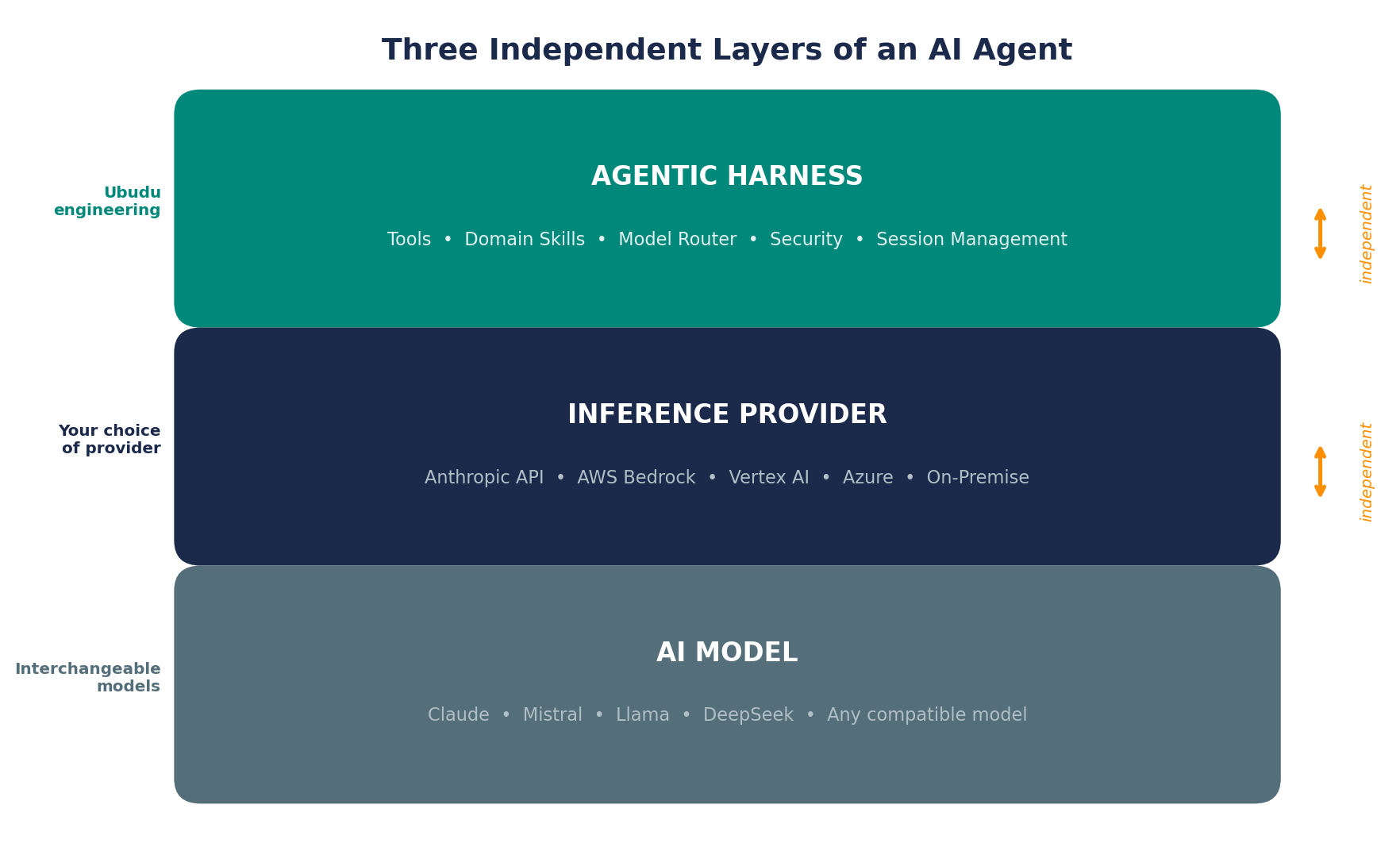
A secured, model-agnostic agentic harness runs on the foundation: isolated per-user sessions, JWT + API key + namespace scoping, three-level tool governance, and human-in-the-loop proposals — mutations are never auto-applied; the agent proposes a change and waits for your Apply/Skip. It runs on any LLM — cloud frontier or open-weight on-prem — and swapping the model is a configuration change.
3 · Agents — Three Agent + Engine Pairings
Three pairings close the perceive → reason → act loop: the Rule Agent over an NLP rule engine, the Script Agent over a safe, sandboxed scripting engine that processes RTLS events in real time — a coding agent writes and tests the scripts, and every change is validated, fixture-tested, and only goes live after you approve it — and the Dashboard Copilot over analytics. In production since 2025. They reach the foundation through a governed interface — the MCP server — described further down.
Built on Real Foundations — By the Numbers
Spatial AI needs a foundation that can keep up with the physical world. Here is ours, in verified figures — the scale and surface area that the harness and agents are built on.
Perceive → Reason → Act, As Shipped Code
The spatial-AI loop is not a manifesto here — it is versioned software running in production. We announced this AI roadmap at VivaTech in June 2025 and shipped it through 2026. Each link below is a concrete, dated capability.
The Four Links of the Loop
The same located tag that reports a position can also be commanded. That write-path is the rare part — most RTLS stops at the dashboard.
Perceive
Eight positioning technologies feed one origin-algorithm map, badged in the UI so you always know the source of a position — BLE, UWB or hybrid BLE/UWB tags.
Expose
A Model Context Protocol server — 44 governed tools across three specialized agents — turns the live facility into a governed, queryable world model. Per-property toggles control exactly which fields a model can read.
Reason
Three agent + engine pairings — Rule Agent, Script Agent and Dashboard Copilot — reason over verified location through the MCP tools, not guessed coordinates: dwell, occupancy, bottlenecks, value stream mapping, plain-language rules and real-time event logic.
Act
When a condition fires, the located tag writes back: an ESL e-paper label updates, a pick-to-light LED turns red or green (1–3,600 s), or a lock responds — each correlated by ID and acknowledged.
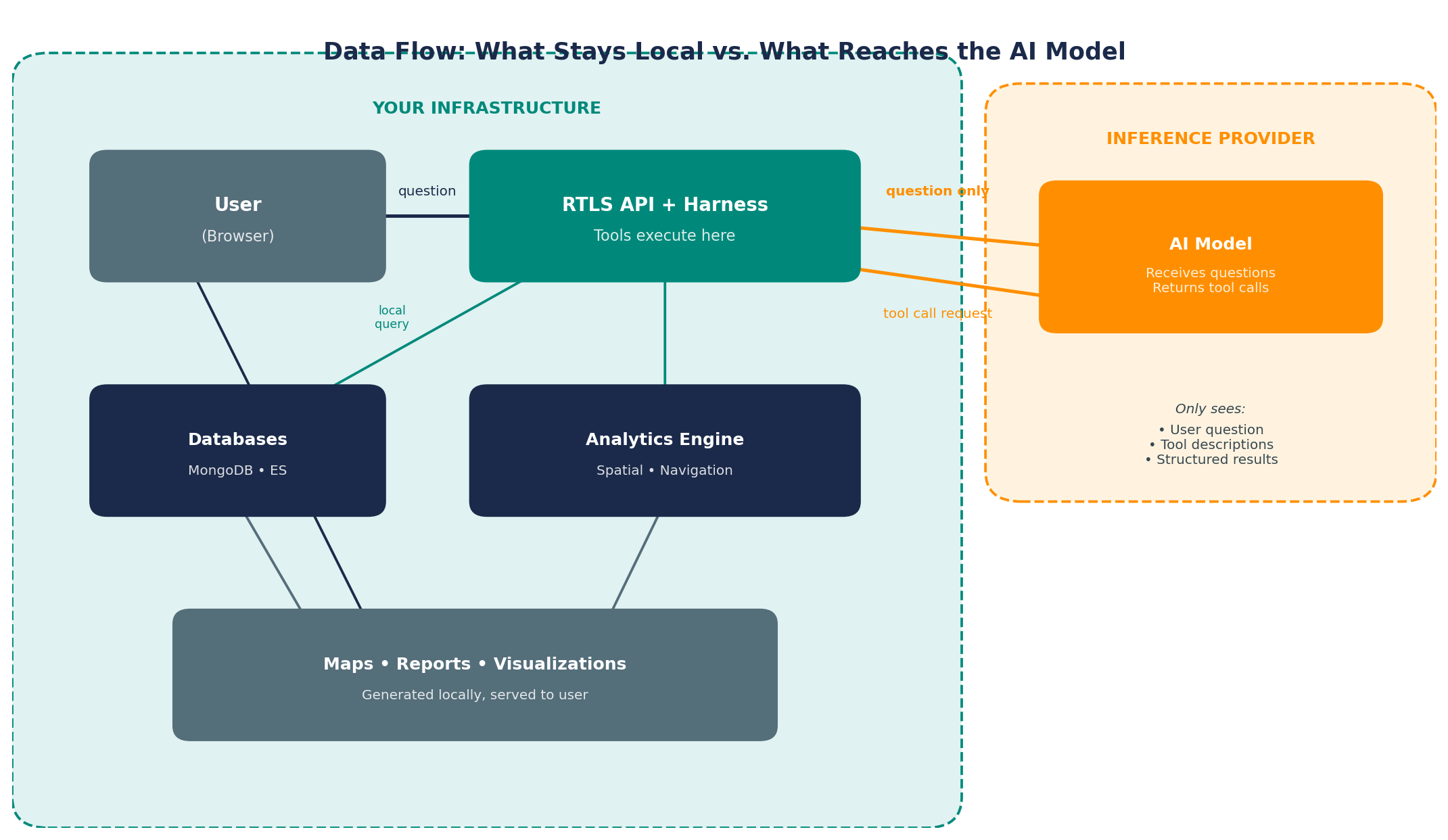
Data-grounded by construction: the model sees only the question, the tool descriptions, and the tool results. Every number it reports is read from live RTLS through governed MCP tools, with field-name validation that rejects fabricated fields — and every physical action lands in an append-only audit trail.
The Closed-Loop Advantage:
Perceive → Reason → Act → Learn
Most RTLS vendors only perceive. Most AI vendors only reason. Ubudu closes the loop with a real physical write-path — and feeds outcomes back to refine rules.
Perceive
BLE, UWB and GNSS positioning across 8 technologies, with origin badges on every track
Reason
Agents reason over verified location through 44 governed tools — any model, cloud or on-prem
Learn
Acknowledged outcomes and dismissed/followed alerts refine rules and spatial awareness
Act
The located tag writes back to ESL displays, pick-to-light LEDs and locks — correlated and ACK'd
BLE 5.4 PAwR — Bidirectional, Actionable Tags
Bluetooth 5.4 introduces PAwR (Periodic Advertising with Responses): the bidirectional RF mechanism that makes a located tag natively actionable. It powers the write-path across our UWB/BLE product line.
The loop runs today
The bidirectional write-path is in production now, with acknowledgement and retry on every action.
Transport-agnostic ACK
The acknowledgement channel accepts a message queue, HTTP webhook or pollable API by design.
Multi-technology tags
Our UWB/BLE tags use BLE 5.4 PAwR to drive ESL displays, pick-to-light and locks natively.
Native bidirectional RF
BLE 5.4 PAwR powers bidirectional, actionable tags across our UWB/BLE product line — the located tag both reports and responds.
What an agent can drive through the write-path:
- ESL displays: update price, instruction or status content, with acknowledgement
- Pick-to-light LEDs: red/green/blue/yellow/white for a chosen duration (1–3,600 s, default 5 s)
- Locks & access: drive electronic locks from the same governed action path
- Every action: correlated by
externalEventId, tracked initiated → success/failed/timeout, logged with transmission time
The Physical Write-Path — The Rare Part
Sending a command is easy. Knowing it arrived — with a transmission time, a correlation ID and a full lifecycle log — is what makes a closed loop trustworthy in operations.
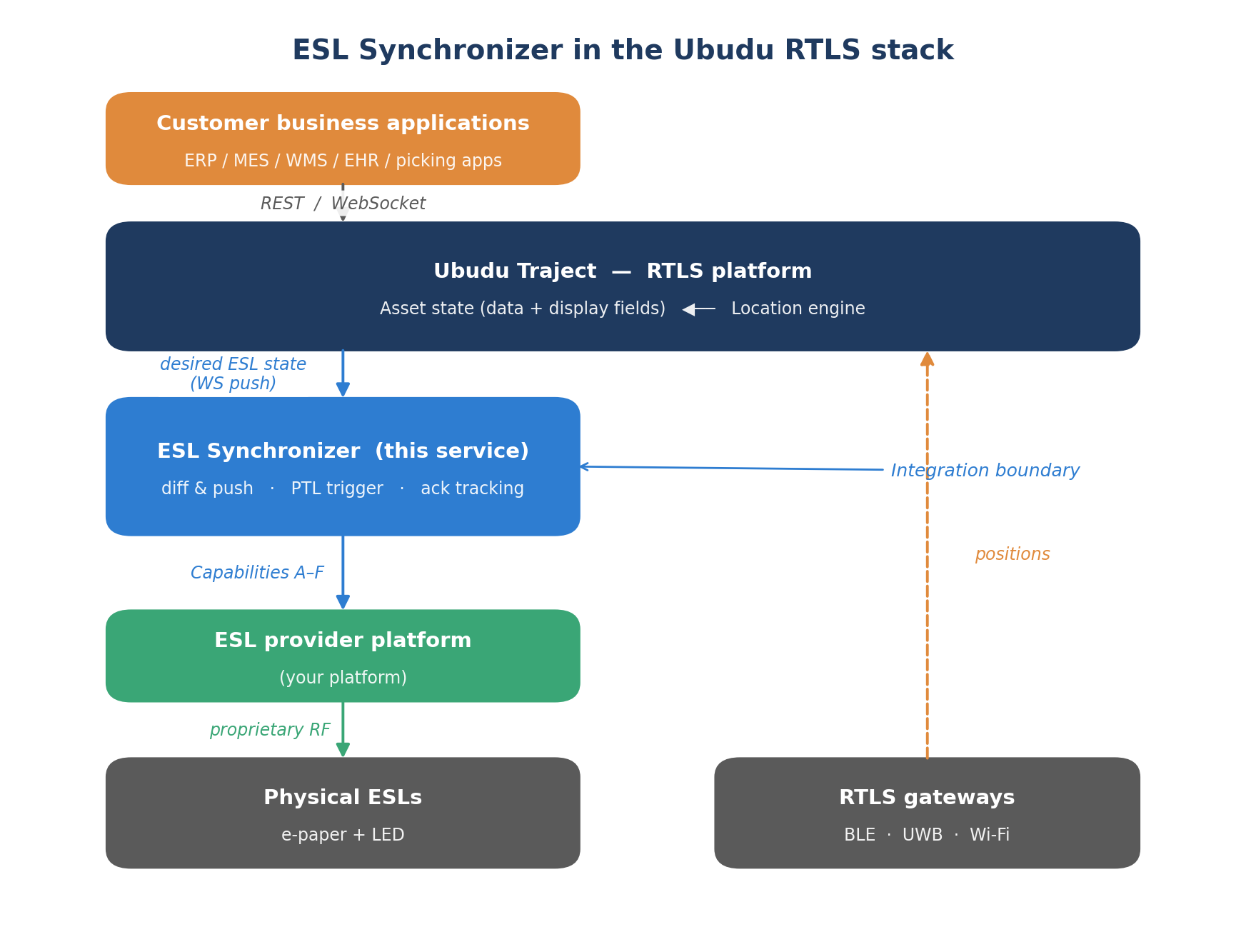
The ESL Synchronizer sends each action with an externalEventId, waits for acknowledgement, handles bounded or infinite retries, and writes the full lifecycle to Elasticsearch — including a real log line such as "Update SUCCESS — transmission 354 ms, elapsed 13.206 s". A per-MAC mutex serialises updates to the same tag while running in parallel across tags.
What Makes the Architecture Hold Up
Six properties that turn "AI over location" into something you can deploy, govern and extend.
Multi-Technology Positioning
In-house tags, anchors and algorithms cover 8 positioning technologies — BLE, BLE Attractor, UWB TWR, UWB TDoA, BLE Presence, Declared, AoA and GPS — through one origin-algorithm map, so an agent always knows the source of a position.
A Spatial Core Built to Carry It
The @ubudu/rtls-core engine runs 6.6M distance operations and 4M point-in-polygon operations per second. Point-in-polygon, radius, distance and custom geometry are exposed as governed tools, not bolted on.
44 Governed Tools, Three Agents
The harness reaches the floor through a governed tool interface — 44 tools across three specialized agents (RTLS discovery, the Script Agent and the Dashboard Copilot). Any MCP-capable assistant reasons over verified location; per-property toggles decide what each model may read.
A Closed-Loop Write-Path
The differentiator: located tags write back to ESL displays, pick-to-light LEDs and locks with externalEventId correlation, retry handling and an append-only audit trail. Powered by BLE 5.4 PAwR across our UWB/BLE product line, running today.
Model-Agnostic Reasoning
Frontier cloud models (Claude, GPT-5, Gemini, or any OpenAI-compatible endpoint) or open-weight models (Mistral, Llama, Kimi, Qwen, DeepSeek, MiniMax) on-prem. Swapping the model is a configuration change, not a rebuild.
Deploy Where Your Data Must Live
The same harness runs across six deployment options, from managed cloud to air-gapped on-prem. For EU data sovereignty, open-weight models run locally and your RTLS data never leaves your infrastructure.
The Governed Interface — How Agents Reach the Foundation
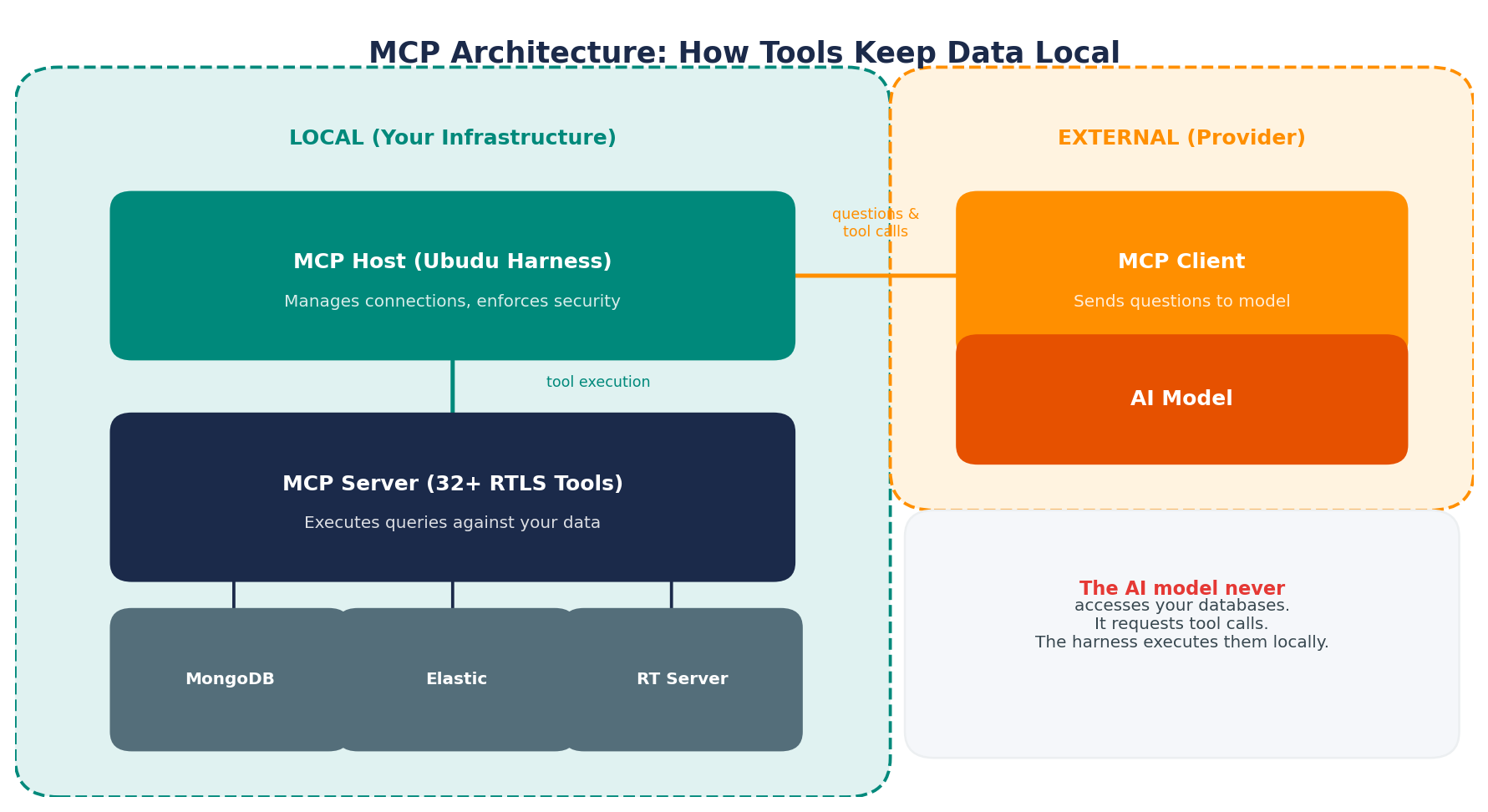
The harness reaches your floor through a governed Model Context Protocol interface — the open standard the agents use to query the foundation safely. Inside the harness, the model, inference provider and policy each change independently: the harness is reusable across cloud and on-prem, and swapping a model is a config change. MCP is the interface, not the product.
Why MCP, Not a Bespoke API
Key take-away: Ubudu Spatial AI is not tied to one API or one model. It plugs into any MCP-compatible client, reasons through 44 governed tools, and acts through the write-path — extensible without changing agent code.
The Deployment Spectrum — Cloud to Air-Gapped
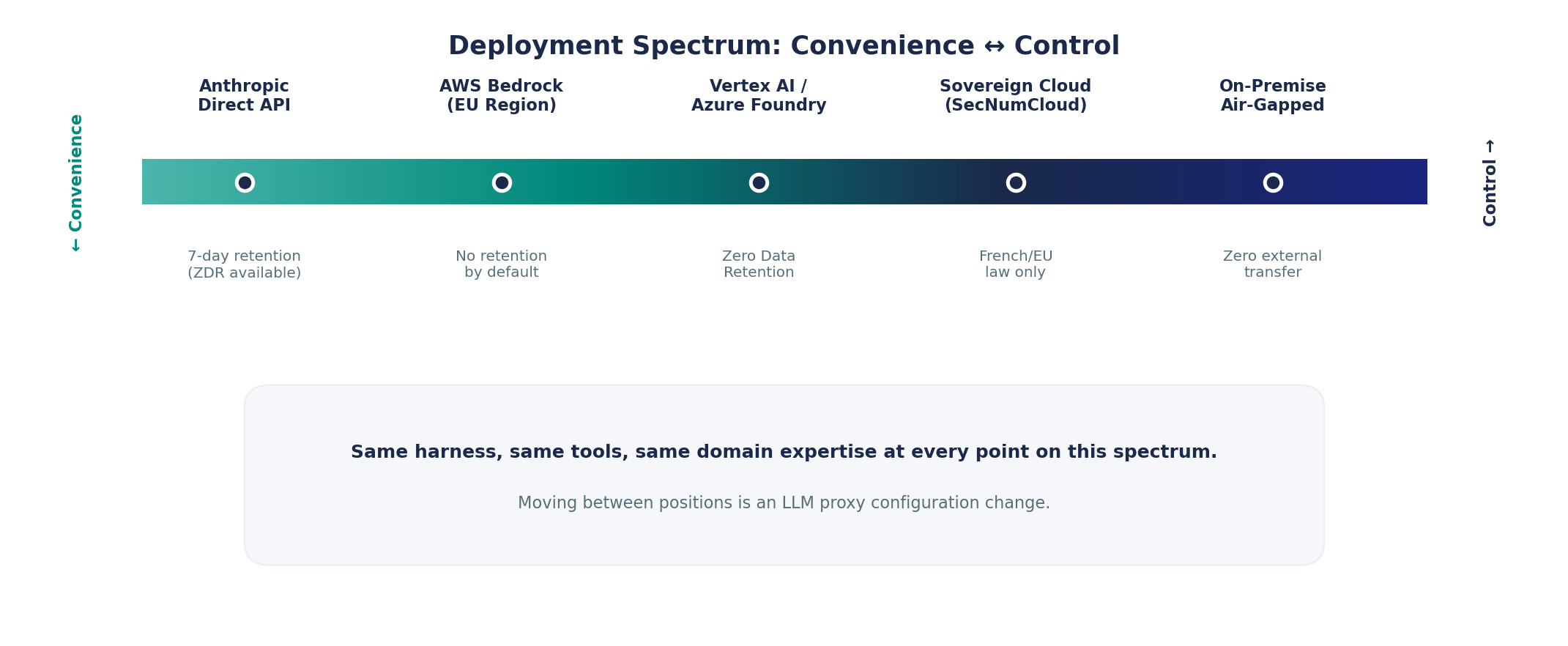
The same agent harness runs across six deployment options. You choose where inference happens; the governed tools and policy stay identical. Move along the spectrum as your data-residency and latency needs dictate — without rewriting agents.
1 · Managed Cloud API
Fastest to start. Inference via a hosted model API; the RTLS data layer stays governed behind the MCP tools.
2 · Cloud-Native Hosting
Run inference inside your own cloud account on AWS Bedrock, Google Vertex or Azure — your contract, your region.
3 · Sovereign Cloud
EU-resident sovereign cloud providers for organisations with strict residency obligations.
4 · On-Premise
Open-weight models run on hardware you control. Position data and inference both stay inside your perimeter.
5 · Edge / Local
Inference close to the floor for low latency, served from a local OpenAI-compatible endpoint.
6 · Air-Gapped
Fully disconnected operation for the most sensitive sites — same harness, same 44 tools, no outbound calls.
EU Data Sovereignty & On-Prem Open-Weight Models
For European operators and regulated industries, the question is not only "is the AI good?" but "where does our data go?" Ubudu's answer: it can stay entirely on your infrastructure.
How Data Stays Local
By construction, the MCP tool-call architecture means the model never holds your database. It receives only the user's question, the tool descriptions, and the tool results it requested — nothing else.
Run Models On-Prem
Open-weight models — Mistral, Llama, Qwen, DeepSeek, MiniMax — run locally on hardware you control, served through any OpenAI-compatible endpoint. Cloud frontier models remain an option when you want them.
Data Never Leaves
With on-prem inference, both the reasoning and the RTLS data stay inside your perimeter. No position history, no asset data, and no tool results cross your network boundary.
Per-User Isolation
Each session is isolated and scoped by JWT, API key and namespace, with a 30-minute cleanup and no persistent AI storage by default. Artifacts are limited to safe formats.
Aligned with GDPR & the EU AI Act
EU regions, sovereign clouds and on-prem open-weight deployment support GDPR and EU AI Act alignment. Spatial analytics agents reading governed RTLS data are not a high-risk category.
For partners and integrators: data sovereignty is a deployment choice, not a product fork. The same MCP server, the same 44 tools and the same write-path ship across every option — so you can offer a customer cloud, sovereign cloud or air-gapped on-prem from one codebase.
From Dashboards to Decisions
Legacy RTLS shows where.
AI adds context.
Spatial AI agents decide what to do next — and act on it.
The Wider Context
The industry direction matches what we ship: AI is moving from reading text to perceiving and acting in physical space. We lead with our own proof above; this framing is secondary, and dated.
From Roadmap to Reality
We set out this AI roadmap at VivaTech in June 2025. Here is what shipped since — live, not slideware — and what's next: two agents that bring AI to the deepest layers of the stack — a Knowledge Base Agent over a decade of deployment know-how, and an ILS Engine Configurator that tunes the solver itself — followed by a visual Agent Builder.
Natural-Language Rule Generation + Governed MCP Server
Describe a rule in plain language; the agent generates, tests and publishes it. The MCP server exposes 44 governed tools across three specialized agents over live RTLS.
RTLS AI Assistant & Dashboard Copilot
Conversational analytics — process-flow mapping, route optimization, value stream mapping — and plain-language dashboard generation. Tested and validated.
Closed-Loop Physical Actions
Agents drive ESL displays, pick-to-light LEDs and locks from the located tag, with externalEventId correlation, retry handling and a full audit trail.
BLE 5.4 PAwR Across the UWB/BLE Product Line
BLE 5.4 PAwR powers bidirectional, actionable tags across our UWB/BLE product line — the located tag drives ESL displays, pick-to-light and locks natively, with acknowledgement and retry.
Knowledge Base Agent
Conversational access to 10+ years of Ubudu knowledge base and platform documentation — so clients and partners can ask how to do something, or why the system behaves a certain way, and get grounded answers that help optimize the technical solution for their use case.
ILS Engine Configurator
Conversational tuning of the solver itself: 100+ positioning parameters across our algorithms and filters — map-matching, particle filtering, fusion — in the C++ multi-hybrid RF RTLS engine. AI applied to the deepest layer of the stack, made operable.
Agent Builder Studio
A visual, drag-and-drop builder for composing custom agents — assemble your own perceive–reason–act workflows without code.
Partnership & Ecosystem Ambition
An open architecture is an invitation. Build on the MCP server and SDK, run it where your customers' data must live, and extend the write-path into your own devices and systems.
Open Standards & European Innovation
- Open Model Context Protocol — a governed MCP server (44 tools across three specialized agents) and a typed TypeScript/JavaScript SDK let any MCP-compatible client connect, with no proprietary lock-in.
- On-prem open-weight LLMs — Mistral, Llama, Qwen, DeepSeek and MiniMax run locally to satisfy EU data-sovereignty requirements and cut latency.
Global & Local Integrators
Certified integrators extend agents into MES, WMS, EHR and SCADA environments — ensuring local support, deployment flexibility and compliance across regions.
Co-Development with Enterprise Clients
Manufacturers, logistics operators and healthcare providers — including a European aerospace manufacturer running ESL update reliability at scale — feed real-world requirements into the roadmap.
Take the Next Step
Pick the lane that fits how you build.
Developers & Partners
The open REST API, TypeScript/JavaScript SDK and governed MCP server (44 tools across three agents) — build on top and ship your own agents.
Developer hubAI Specialists
A governed MCP server over verified location, a model-agnostic menu, three thinking modes and agentic patterns.
The agentsOperations & Business
The same architecture, expressed as outcomes — without a developer in the loop.
See use casesCompliance & IT
Deployment spectrum, data sovereignty, GDPR and EU AI Act alignment — answered plainly.
FAQ & glossaryQuick Answers
- What makes MCP different from a plain REST API?
- MCP is an open standard (Linux Foundation) for exposing governed tools to AI. The model never touches your database — it calls pre-defined tools that run server-side, scoped by namespace, JWT and API key. We ship a governed MCP server — 44 tools across three specialized agents — and a typed SDK alongside it.
- Can we keep all data on our own infrastructure?
- Yes. Run open-weight models (Mistral, Llama, Qwen, DeepSeek, MiniMax) on-premise through an OpenAI-compatible endpoint. With on-prem inference, both reasoning and RTLS data stay inside your perimeter — up to fully air-gapped operation.
- Cloud or on-prem?
- Both, across six deployment options — managed cloud API, cloud-native (Bedrock/Vertex/Azure), sovereign cloud, on-premise, edge/local, and air-gapped. The same agent harness and 44 tools run everywhere.
- Is BLE 5.4 available today?
- Yes. BLE 5.4 PAwR powers bidirectional, actionable tags across our UWB/BLE product line. The multi-technology tags use PAwR to drive ESL displays, pick-to-light and locks natively, with acknowledgement and retry on every action.
- Do we need new hardware?
- If you already run Ubudu BLE / UWB / GNSS tags and anchors, the agents and physical actions run on that same infrastructure. New sites deploy the location layer first.
- How does this fit GDPR and the EU AI Act?
- EU regions, sovereign clouds and on-prem open-weight deployment support alignment with GDPR and the EU AI Act. Spatial analytics agents reading governed RTLS data are not a high-risk category. Sessions are isolated, with no persistent AI storage by default.
- How do we trust a physical action happened?
- Every action carries an
externalEventId, is tracked through its lifecycle (initiated → success/failed/timeout), and is logged with its transmission time — e.g. "Update SUCCESS — transmission 354 ms, elapsed 13.2 s" — to an append-only audit trail. - First step?
- Book an online demo. We'll walk through your architecture, deployment model and use case, and show the agents acting on real RTLS data.
See the Architecture In Action
Book a 30-minute technical demo.
We'll walk the foundation, the harness, the write-path and your deployment options — on real RTLS data.