
Most RTLS platforms see the floor.
Ubudu acts on it.
Welcome to the Spatial AI Era
AI that doesn't just think — it sees, understands, decides, and acts in physical space.
Processing 100,000+ positions/second — so AI reasons over verified location, then triggers ESL displays, pick-to-light and locks.
Meet the Agents
Production-proven AI agents on real RTLS data — with a harness that runs on any LLM. Live since 2025, not slideware.

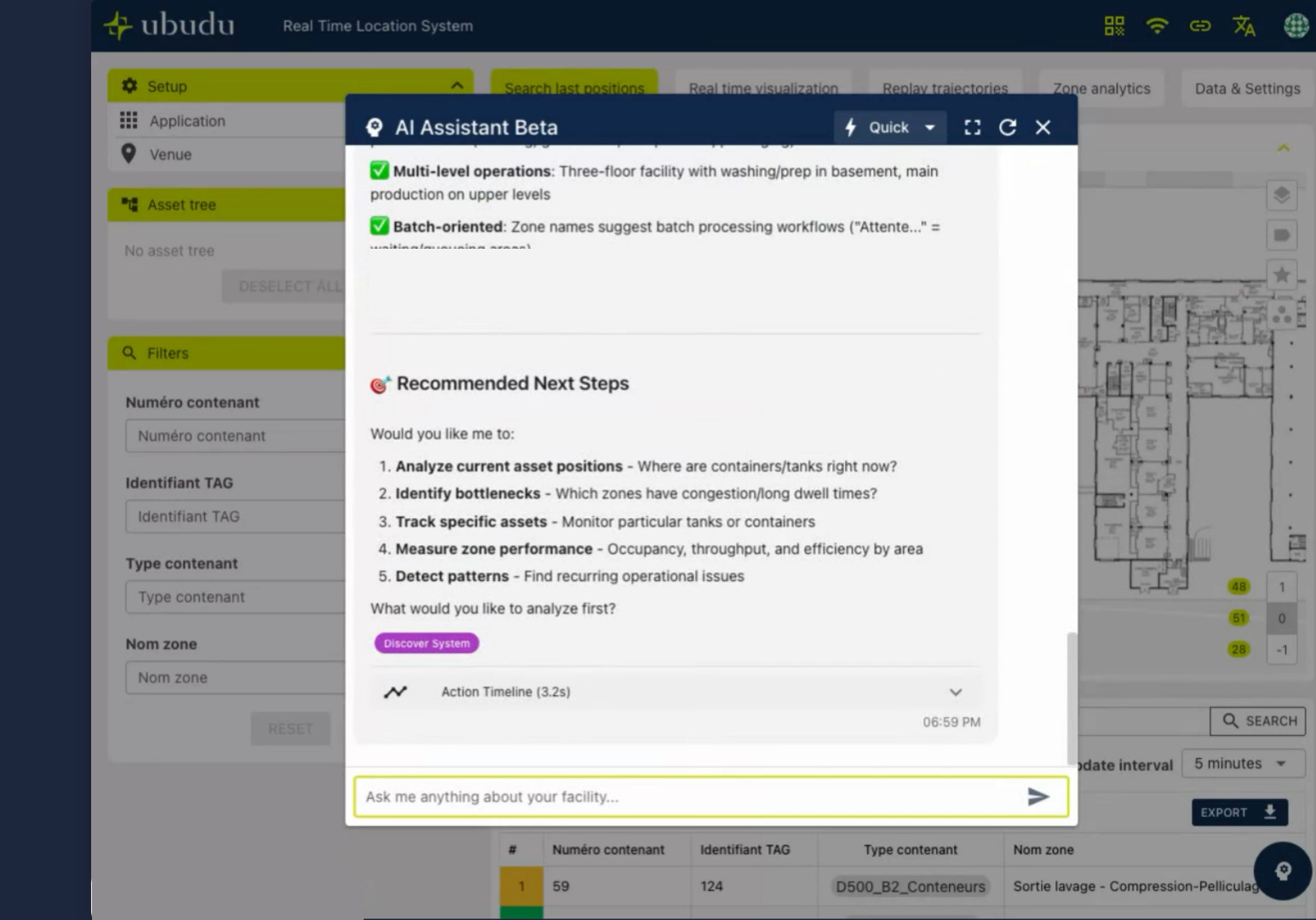
RTLS AI Assistant
Ask in plain language; get answers with interactive maps and clickable actions. Map process flow, surface bottlenecks, optimize routes — all conversationally.

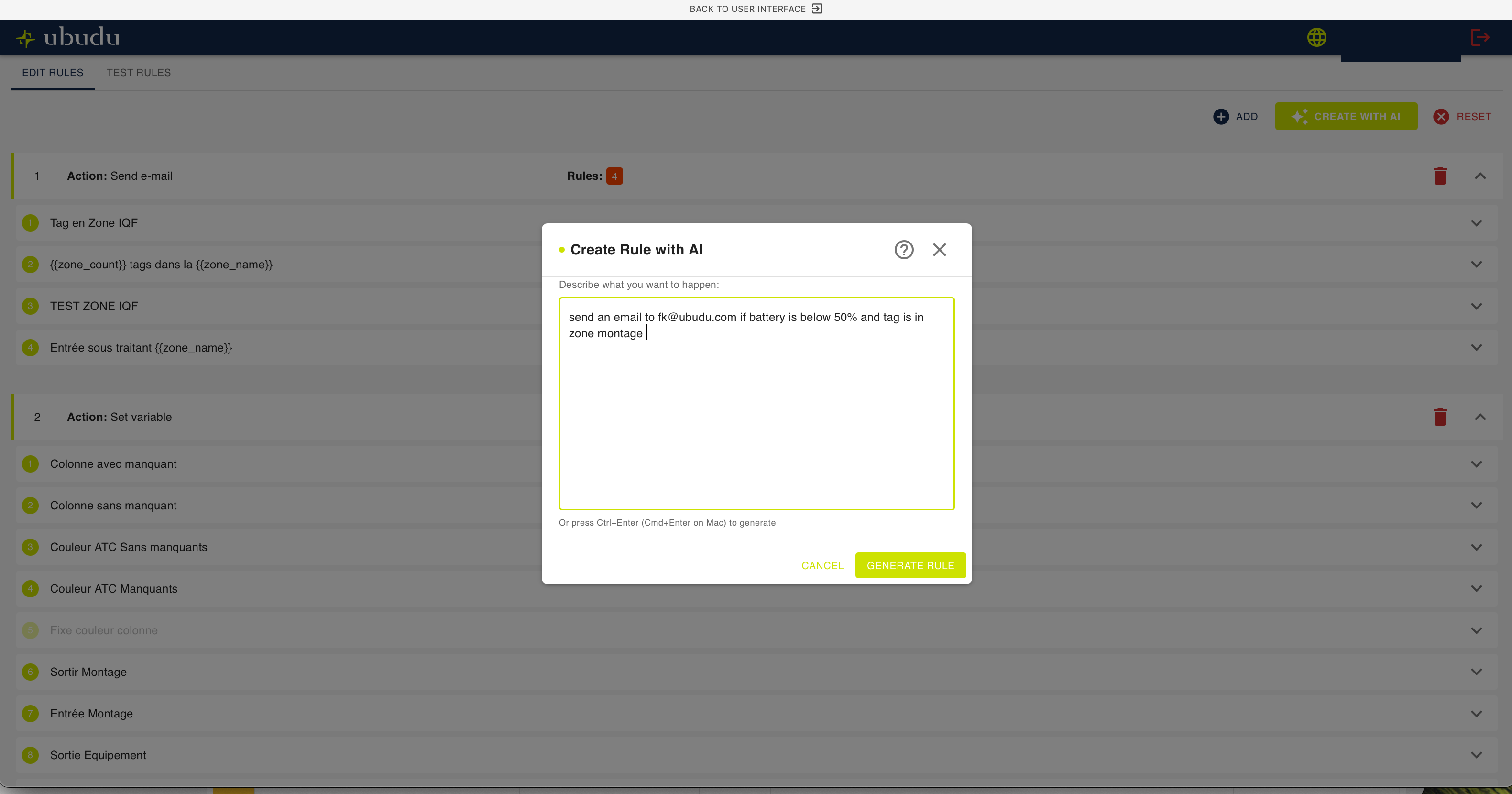
Speak → Rule Agent
Describe a monitoring rule in plain language. The agent writes the rule against our NLP rule engine, generates test cases, and you publish it — no JSON by hand.

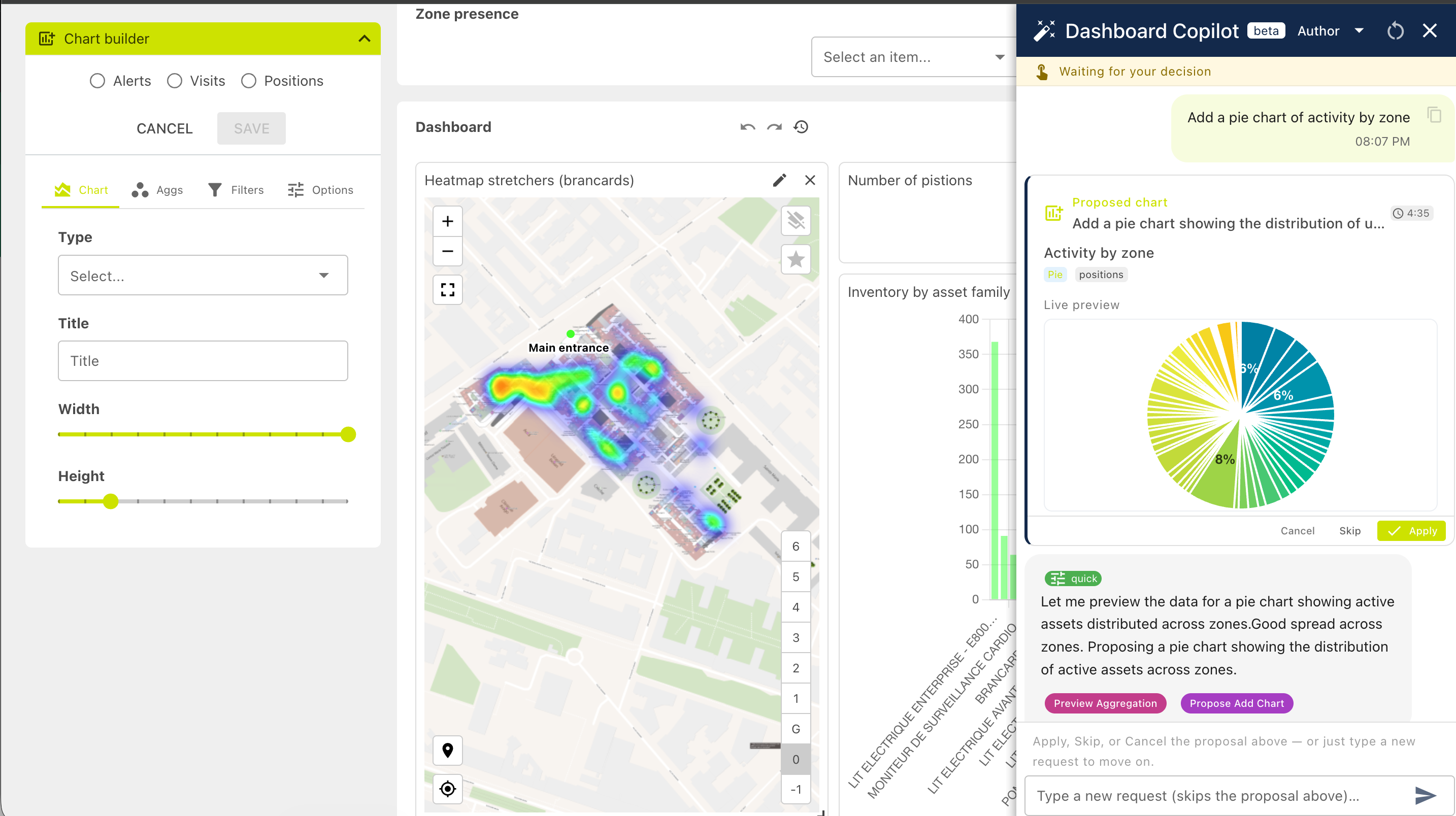
Describe → Dashboard Copilot
Turn a plain-language request into a ready-to-use chart or dashboard. The copilot proposes it with a live preview, and nothing changes until you confirm.

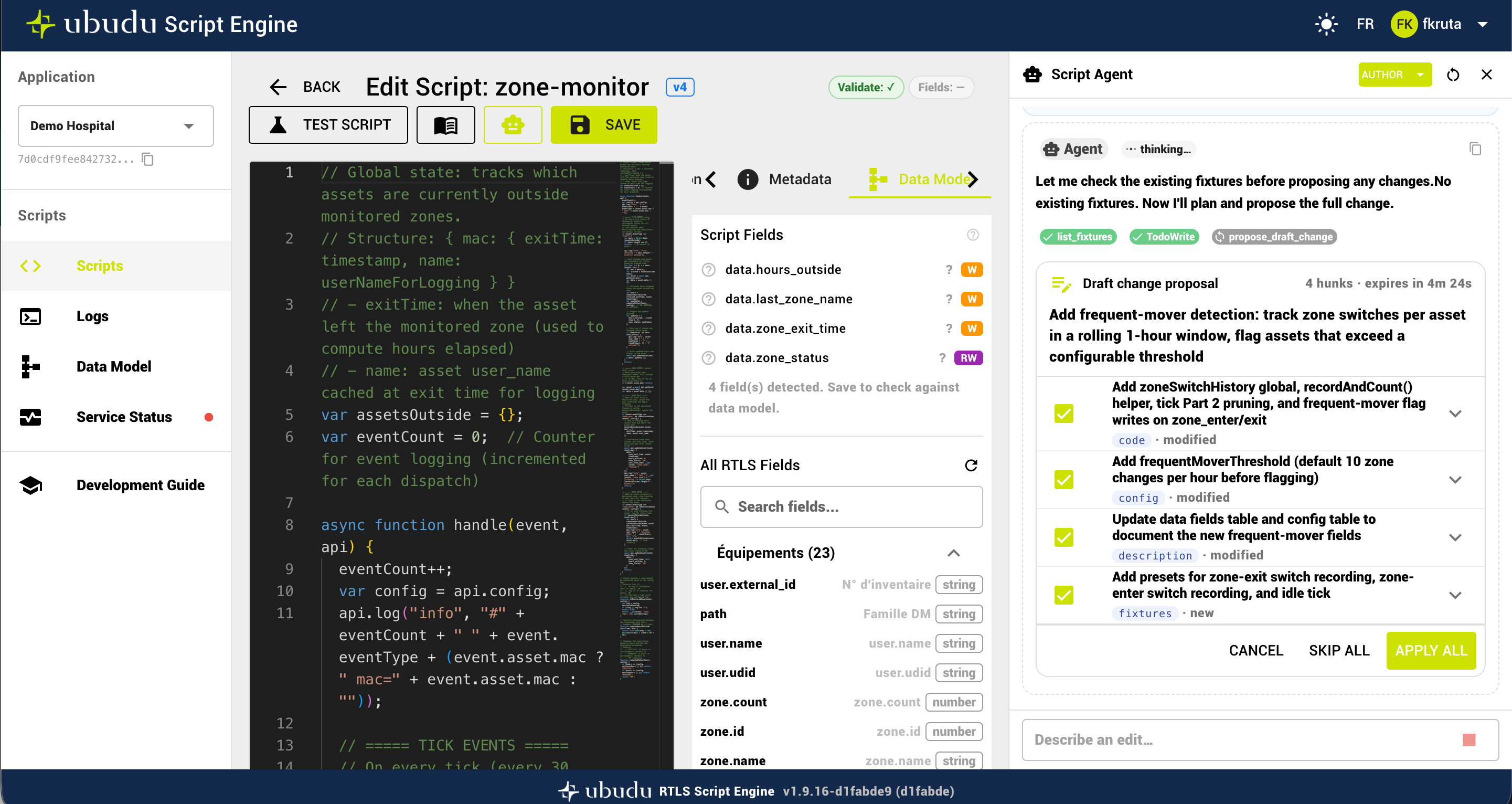
Describe → Script Agent
A coding agent that writes and tests safe scripts for real-time RTLS event processing. Describe it, the agent proposes and tests against fixtures, you deploy.
The Value Isn't a Chatbot — It's the Harness
What we built is a full agentic harness: the orchestration, governance and grounding that lets an agent reason over your real floor and safely act on it. It's scalable, it's secured, and it runs on the LLM of your choice.
Scalable
A spatial core handling millions of geometry operations per second, multi-instance scaling, and deployment from cloud to fully on-premise.
Secured
Isolated per-user sessions, scoped access by namespace, governed tool access, human-in-the-loop confirmation, and an audit trail on every action.
Model-Agnostic
The same harness runs on any LLM — a frontier cloud model or an open-weight model on your own infrastructure. Swapping models is a configuration change.
Proven
In production since 2025, closing the perceive → reason → act loop on real RTLS data — reaching your floor through a governed interface.
The harness stands on years of engineering: a foundation of spatial primitives and scalable querying tools — the same core that powers our rule engine, analytics copilot and script agent. The agents are the top layer of a deep stack, not a bolt-on.
Built on Real Foundations
Spatial AI needs a foundation that can keep up with the physical world. Here's ours — by the numbers.
100,000+
positions / second
real-time processing architecture
6.6M / sec
spatial operations
distance & geometry in the spatial core
130
REST endpoints
across 20 modules, 20+ query operators
8
positioning technologies
BLE · UWB · GNSS & more, fused as one
A zero-dependency spatial core of 140+ pure functions (10,000 zones searched in under 5 ms), 130 REST endpoints across 20 modules, real-time WebSocket streaming with multi-instance scaling, and sub-second physical actions — the substrate the agents are built on. Deployable from cloud to fully on-premise.
One Loop, Start to Finish
A real example: a low-battery rule, authored in plain language, that ends with a light turning on at the tag.
1 · Describe
"Alert when a tag's battery drops below 20% in the assembly zone." Typed in plain language.
2 · Generate & test
The agent writes the rule against our NLP rule engine and runs generated test cases. You publish it.
3 · Monitor
Live position from BLE / UWB / GNSS is matched against the rule in real time — verified location, not guesses.
4 · Act
The condition fires: the tag's pick-to-light LED turns red — and the action is logged with its transmission time.
Data-grounded: every number the agent shows is read from live RTLS through governed MCP tools — and every physical action is acknowledged and written to an audit trail (e.g. Update SUCCESS — transmission 354 ms).
Why Spatial AI Changes Everything
This is not an interface upgrade—it's the step from RTLS that shows to spatial AI that sees, understands, and acts on the same infrastructure — and increasingly optimizes that infrastructure itself.
What Spatial AI Unlocks
Same RTLS infrastructure. Radically faster customization and insights.
Spatial AI doesn't just sit on top of the RTLS engine — it increasingly tunes the engine itself, so getting accurate location no longer depends on scarce RF expertise.
The Easy Front-End to a Real Engine
The power was already there. Three real engines — an NLP rule engine, a safe real-time script engine, and analytics — have run in production for years on a platform built to scale. Each now has a plain-language front-end: a specialized agent that writes, tests and proposes the work, so an operations team can use it without a developer.
Rule Agent → NLP Rule Engine
Geofences, dwell and alert rules — historically integrator work. Now: describe them in plain language and the agent builds, tests and publishes them against the rule engine.
Script Agent → Script Engine
A safe, sandboxed scripting engine for processing RTLS events in real time — with a specialized coding agent that writes and tests the scripts for you. Every change is validated, fixture-tested, and only goes live after you approve it.
Dashboard Copilot → Analytics
Value stream mapping, throughput, dwell and bottlenecks. Ask a question in plain language instead of filing a dev ticket — the copilot proposes charts you preview and confirm. Self-service insight.
Scalable, Secured Harness
All three agents run on one production harness — isolated sessions, scoped access, governed tools, full audit trail — and a spatial core handling millions of geometry operations per second.
Agents You Can Use Today
Four real AI agents on live RTLS data — Rule Agent, Script Agent, Dashboard Copilot and the AI Assistant. All live.
Data-grounded: the model orchestrates — every number is read from live RTLS through our governed MCP tools, with field names validated against your live data model.
RTLS AI Assistant
Conversational AI over governed tools on the harness. Ask questions, get insights, create interactive dashboards.
Speak → Rule Agent
Describe alerts in plain English. AI generates, tests, and deploys rules—no code required.
Describe → Dashboard Copilot
Turn a plain-language request into a ready-to-use chart or dashboard — proposed with a live preview, applied only when you confirm.
Describe → Script Agent
A coding agent that writes and tests safe scripts for real-time RTLS event processing — propose, test against fixtures, deploy.
From Insight to Action
AI doesn't just answer questions—it generates clickable links that control your RTLS interface.
AI Finds Issue
"45 containers stuck in bottleneck zone"
Generates Link
"View on map →"
UI Responds
Assets highlighted on map
Physical Action
The located tag responds — and acknowledges
Pick-to-Light
Turn a tag's LED red or green for a set duration to locate an asset instantly.
ESL Displays
Update an electronic shelf label's content — price, instruction or status — with acknowledgement.
Locks & Access
Drive electronic locks and access points from the same located, governed action path.
Tracked & Audited
Every action is correlated by ID, acknowledged, and logged with its transmission time.
BLE 5.4 PAwR powers bidirectional, actionable tags across our UWB/BLE product line — our multi-technology tags use BLE 5.4 PAwR to drive ESL displays, pick-to-light and locks natively.
From Roadmap to Reality
We set out this AI roadmap at VivaTech in 2025. Here's what shipped since — and the one thing still on the way.
Speak → Rule Agent
Plain language to production-ready rules, generated and tested. Live.
RTLS AI Assistant
Governed tools on the harness: process-flow mapping, route optimization, deep analysis.
Dashboard Copilot
Describe a chart in plain language; preview and apply it. Tested and validated.
Closed-Loop Physical Actions
Agents drive ESL displays, pick-to-light LEDs and locks from the located tag — with acknowledgement and audit trail.
BLE 5.4 PAwR Hardware
BLE 5.4 PAwR powers bidirectional, actionable tags across our UWB/BLE product line — driving ESL displays, pick-to-light and locks natively.
Knowledge Base Agent
Conversational access to 10+ years of Ubudu knowledge base and platform documentation.
ILS Engine Configurator
Conversational tuning of 100+ positioning parameters — map-matching, particle filtering, fusion — in our C++ multi-hybrid RF RTLS engine.
Agent Builder
A visual drag-and-drop builder for composing your own custom agents.
Solutions by Industry
AI agents tailored to your operational challenges
Manufacturing
VSM, bottleneck detection, pharma compliance, WIP tracking
ExploreLogistics
Asset tracking, route optimization, pick-to-light, idle detection
ExploreHealthcare
Equipment tracking, compliance rules, patient flow optimization
ExploreRetail
Customer flow, staff positioning, dwell time, dynamic pricing
ExploreQuick Service
Kitchen flow, order fulfillment, station optimization
ExploreQuick Answers
- Is this compatible with my current software?
- Yes. Connect over a REST API, our TypeScript/JavaScript SDK, or the MCP server — agents work alongside your MES, WMS, EHR or custom systems. No rip‑and‑replace.
- Do I need new hardware?
- If you already run Ubudu BLE / UWB / GNSS tags and anchors, the agents and physical actions run on that same infrastructure. New sites need the location layer deployed first.
- Which AI models can I use?
- It's model-agnostic. Use a frontier cloud model or run an open-weight model on‑premise for data sovereignty — your choice, swappable by configuration.
- How do I start?
- Book an online demo. We'll walk through your use case and show the agents acting on real RTLS data.
Find Your Path
Spatial AI meets you where you are.
Operations & Business
Outcomes, ROI and self-service insight — without a developer in the loop.
See use casesDevelopers & Partners
Open REST API, SDK and MCP server to build on top — and your own custom agents.
Developer hubTechnical Buyers
Architecture, multi-technology hardware, and cloud-to-on-prem deployment with data sovereignty.
The architectureAI Specialists
A secured, model-agnostic agentic harness over verified location — 44 governed tools across three agents, and agentic patterns.
The agentsSee It In Action
Book a 30-minute online demo.
We'll show you AI agents acting on real RTLS data—and discuss your specific use case.